The sign in the window is on your side
We had started describing this sign on our own website without ever having photographed one. That bothered us, so on 9 September 2026 we went out and found one, in a window in Toronto, and took a picture of it.
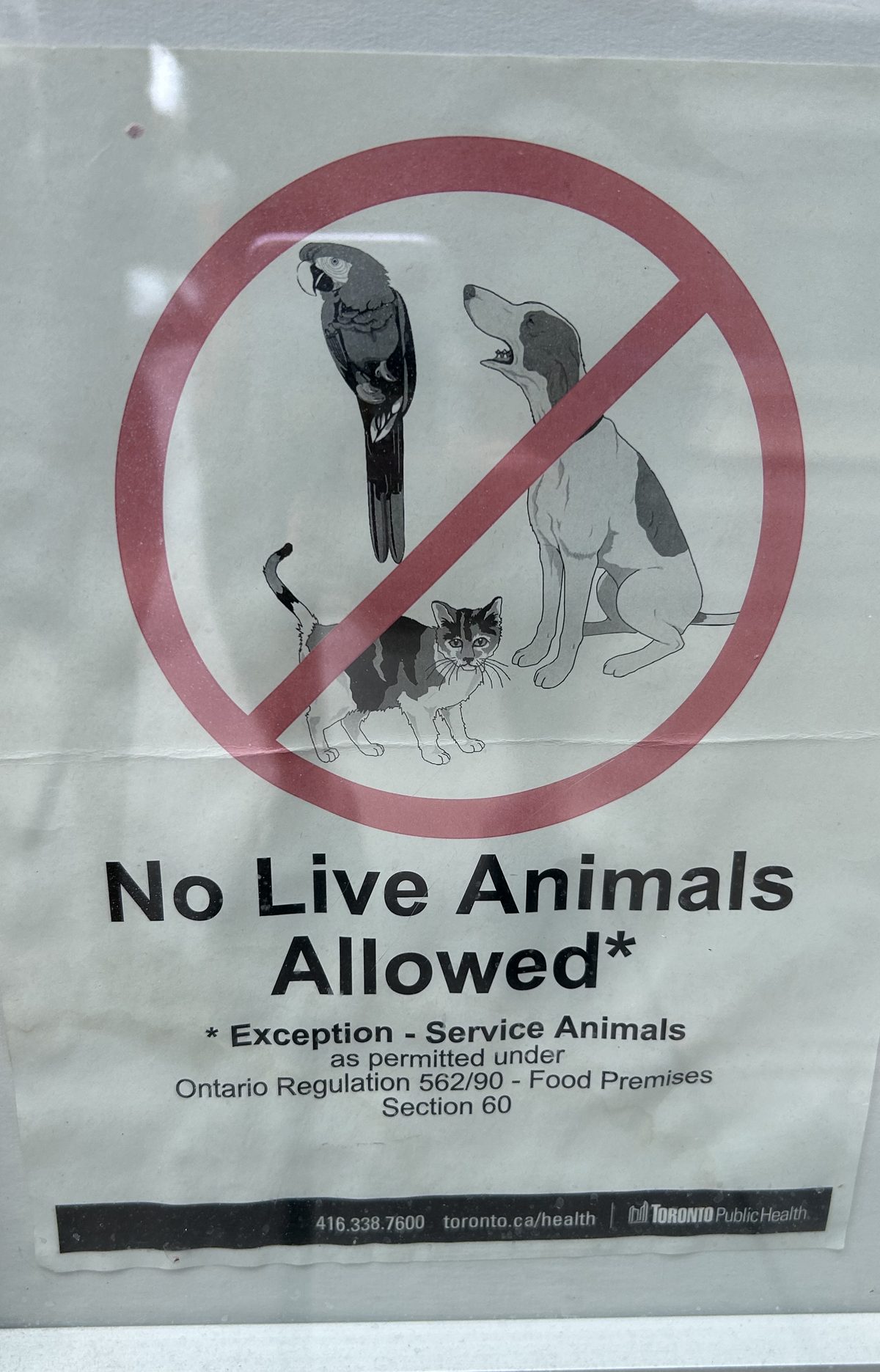
It is doing the opposite of what most people think it is doing.
The largest type on the page says No Live Animals Allowed*. Then the asterisk, in type less than half the size, carrying the whole meaning:
* Exception - Service Animals
as permitted under
Ontario Regulation 562/90 - Food Premises
Section 60
Toronto Public Health's name and phone number run along the bottom. It is their sign.
Almost nobody reads the footnote. The handler doesn't, because by the time you have been turned away twice you read the headline and brace. The eighteen-year-old on the till doesn't, because nobody trained them on the asterisk. So two people who agree with each other end up in an argument at a doorway.
Read the footnote first. That sign is not a refusal. It is the notice their own public health unit wrote for them to post, and it says a service dog is the exception to it.
What the rule underneath it actually says
Ontario's food premises regulation is short on this point. Section 14(1) of O. Reg. 493/17 sets the general rule: "Every room where food is prepared, processed, packaged, served, transported, manufactured, handled, sold, offered for sale or displayed shall be kept free from live birds or animals."
That is the headline on the sign. Section 14(2) is the asterisk — a list of exceptions, of which the first is: "Service animals described in subsection 80.45 (4) of Ontario Regulation 191/11 (Integrated Accessibility Standards) made under the Accessibility for Ontarians with Disabilities Act, 2005 that are in an area of the food premise where food is served, sold or offered for sale."
Toronto Public Health puts the same thing in one sentence on its own page for food businesses: "Service animals are allowed in any area where food is served, sold or offered for sale."
Two things worth carrying with you.
The first is that the poster cites a regulation that no longer exists. O. Reg. 562/90 was replaced on 1 July 2018 by O. Reg. 493/17, and the rule moved from section 60 to section 14. Plenty of these signs are still in windows, still naming the old one. The sign is out of date and the answer is unchanged — the current rule lands in exactly the same place. Nobody has to lose face over this. The poster is old, not wrong.
The second is the limit written into the exception, and we are not going to pretend it isn't there. It covers where food is served, sold or offered for sale — the room you eat in, the counter you order at. It does not cover the kitchen. Asking to bring your dog behind the pass turns a strong position into a weak one in a single sentence.
The detail of the Ontario test — the two ways of showing it, and the nine health professions whose letter counts — is set out on our Ontario page, which quotes the subsection. The step-by-step for the moment itself is in the refused-entry guide.
Show the record first
Here is the part that is ours, and the reason we built what we built.
The person at the door is almost never hostile. They are guessing, in public, with a queue behind you, about a rule they were told once. What ends that fastest is not an argument about the law. It is something to look at.
So: walk in, don't wait to be challenged, and if someone stops you, show your ServDog record before they ask for anything. The card on your phone or the printed one, or the dog's profile — its name and photo, the registration number, the status, and, if you have chosen to turn it on, a short summary of what the dog is trained to do. Say what it is while you hand it over: my dog is registered with ServDog, its training is on record, and this is what it does. That is a record you keep, not a government certificate, and you do not need to claim more than that. Then point at their own poster.
Registration is not required anywhere in Canada, and nothing we issue creates a right of entry. What a door needs is an answer, and what a complaint needs is a record. That is the job.
If they still say no
In Toronto there is a route people rarely hear about. The City's own by-law enforcement page is blunt: "All businesses licensed by the City of Toronto must provide service to individuals with guide dogs or service animals." You report it to 311, an officer attends, and the first step is educating the owner — but "A $500 ticket can be issued," and enforcement escalates from there.
That sits alongside, not instead of, a human rights complaint. Both start with the same thing: what you wrote down that evening.
One honest note about emotional support animals
The exception on that sign is for service animals as the accessibility regulation describes them, and Ontario's test does not ask what you call your dog. It asks for one of two things: a dog readily identifiable as a service animal by a vest or harness, or a letter from one of the regulated health professionals the subsection names. An animal that is only an emotional support animal — no visual indicator, no letter from one of those professionals — is not covered by the exception, and a record from us does not change that. We would rather say it here than let you find out at a door.
You will still see dogs on patios, and that is not someone else getting away with something. Paragraphs 4 and 5 of the same subsection let an operator choose to admit dogs in an outdoor eating area where no food is prepared, and in an indoor room where only low-risk or pre-packaged, ready-to-eat food is served and no food is prepared there. That is the operator's discretion, not your entitlement — and a record from us does not turn it into one. The difference between the categories, in plain terms.
There is no national standard in Canada, no private registry — ours included — that grants entry anywhere, and we do not sell clinician letters. What we sell is a tidy, dated record of a real dog and real training: something to hand over, instead of an argument to win.
Last reviewed: 9 September 2026.